
Sample memoir chapter
The Recipe Box
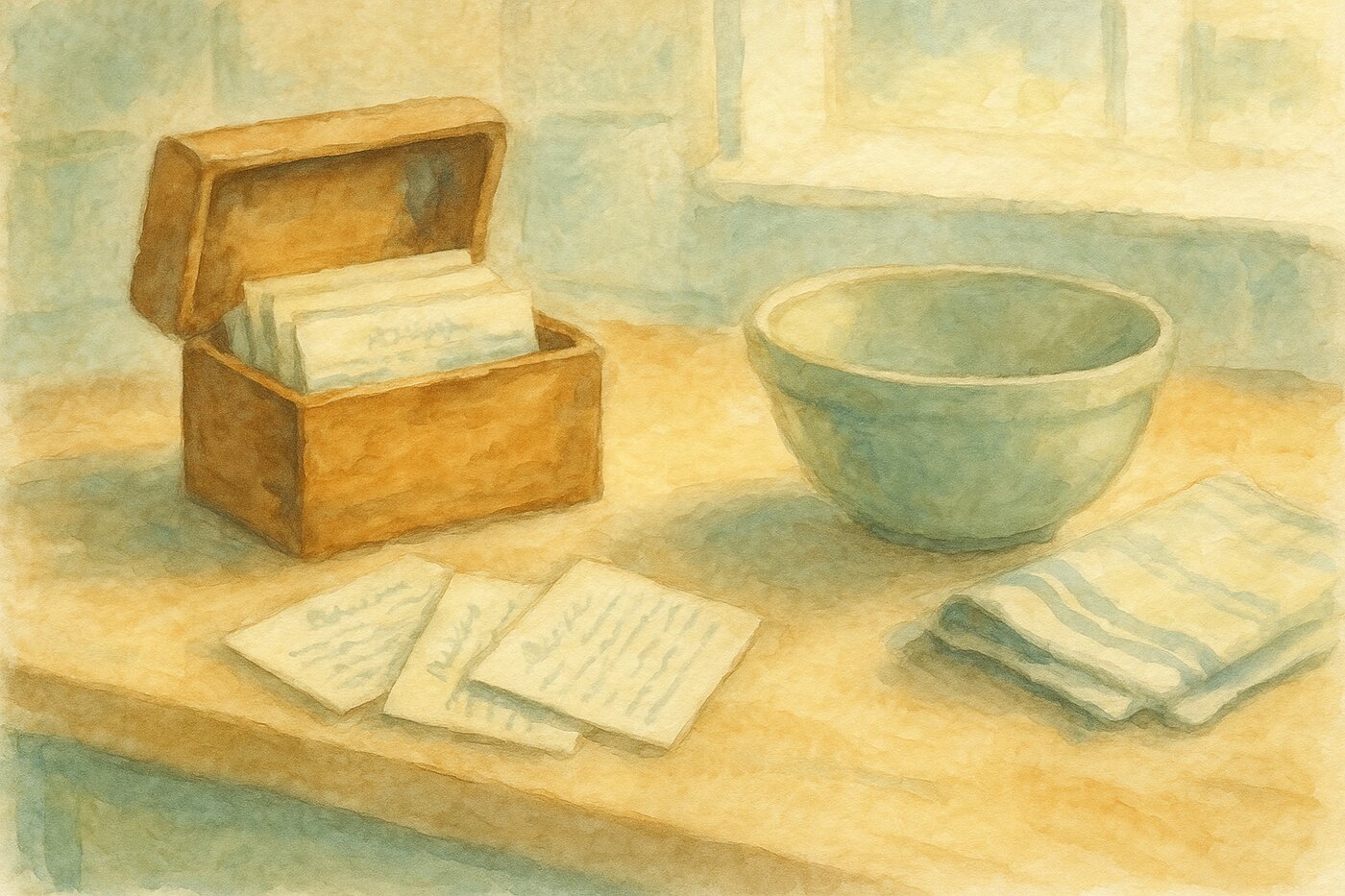
The recipe box sat on my mother's counter for fifty years before it came to mine. It's nothing to look at: tin, dented on one corner, the little rose decal worn down to a ghost. But every card inside it is in her handwriting, and every card is a day I can still taste. The bread we baked the morning after the tornado took the barn. The pot roast that won your grandfather over. The molasses cookies we made by the dozens the winter your great-uncle came home from the service.
I was born on the farm in 1946, the fourth of six children, and I learned to cook the way I learned everything else: standing on a kitchen chair, watching, being handed the parts of the job nobody else wanted. Shelling peas. Pinching pie crust. My mother didn't measure anything, and when I asked her how much flour went in the biscuits she'd say, "Enough." It drove me wild then. Now I understand it was the truest recipe she had: you learn a thing by doing it beside someone who loves you.
Money was thin in those years, though I didn't know it at the time. What I knew was that our table always had room. Hired men, neighbors down on their luck, the schoolteacher who boarded with us one autumn. My mother fed them all out of that recipe box, stretching a Sunday chicken until it was Thursday soup. When I asked her once why she gave so much away when we had so little, she wiped her hands on her apron and said, "Nobody's poor who can set another plate." I have tried my whole life to live up to that sentence.
Your grandfather came courting in the spring of 1965. He was tall and too quiet and he'd driven forty minutes on a tractor road to take me to a church social. My mother sized him up in one look and made him her pot roast, the one with the coffee in the gravy, though she'd never have admitted to it. He proposed four months later. For our whole marriage he swore he married me for that pot roast, and for our whole marriage I never told him it was my mother's doing. A wife is entitled to one or two secrets.
We raised three children in the house on Cedar Street, and the recipe box filled up alongside them. Birthday cakes. Funeral casseroles. The divinity candy that only sets right in dry weather, which in our county meant about four days a year. When your grandfather passed, the house went quiet in a way I didn't know a house could. It was the recipe box that got me up mornings, that first winter. Someone was always sick, or grieving, or new to town. Nobody's poor who can set another plate.
I'm telling you all this because a recipe card only holds the smallest part of it. "Brown the roast. Add the onions." It doesn't say that the kitchen smelled like rain through the screen door, or that my mother hummed hymns off-key while she worked, or that love, in our family, has always been something you could put on the table and pass to your left. That's the part I want you to have: the part that was never written down. Until now.
Every family has a recipe box: stories held by one person, waiting to be asked for.